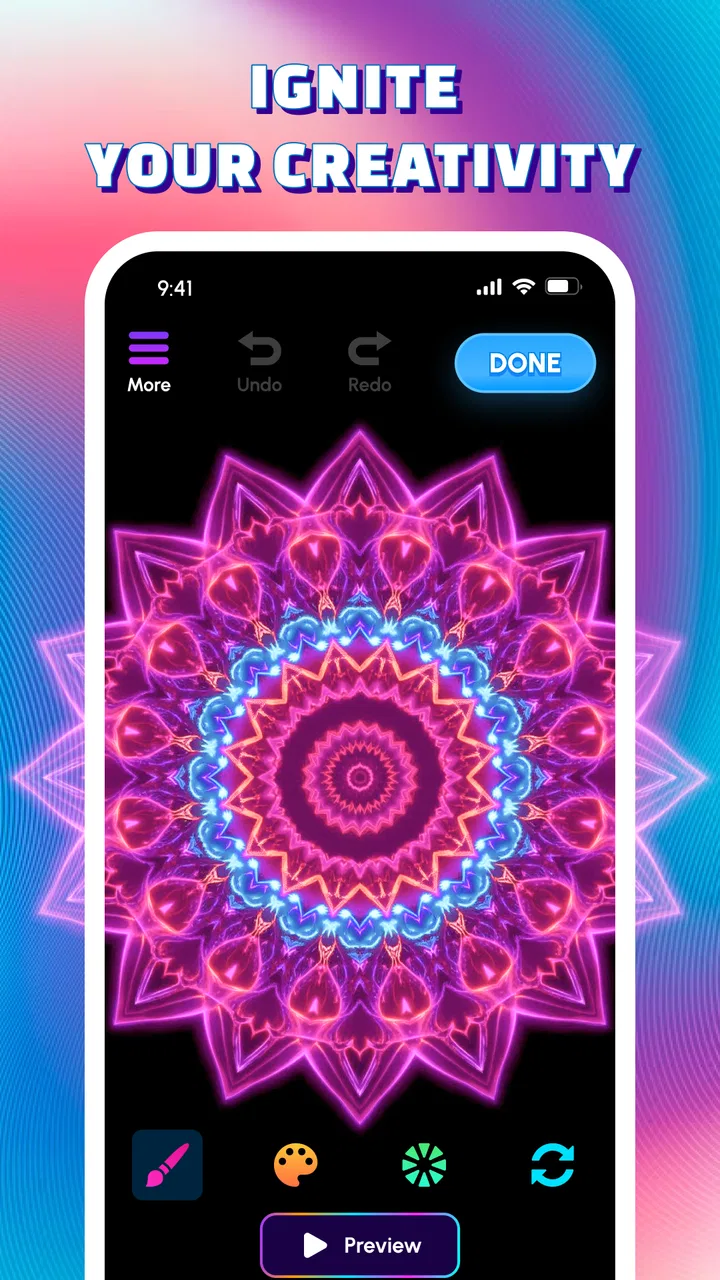
Glow Art Drawing - Doodle App
- 4.2
- Rating
- 5.00M
- Installs
- Free
- Price
 Analysis by App-foxy
I tried Glow Art Drawing - Doodle App as a quick creative tool rather than as a full digital-art studio, and that distinction matters. It is an Art & Design app from Braly JSC that focuses on the simple pleasure of drawing with a glowing visual style. The idea is easy to understand: open it when you want to sketch, decorate an idea, or let someone experiment with colorful lines without first learning a complicated interface.
That simplicity makes it especially interesting on a shared household device. A parent, teenager, younger child, or visiting friend can pick it up and begin drawing without needing to understand layers, brushes, canvas settings, or a professional workflow. I found the best use was not replacing a serious illustration program, but filling those small moments when somebody wants to make something immediately.
The app is free, carries an Everyone age rating, and has reached over a million installs. Its average rating is 4.1 from around 180 ratings, which suggests that many users enjoy the basic concept while still leaving room for individual preferences about controls and creative depth. It runs on Android 7.0 or later, so it can suit older phones and tablets that may not handle newer, heavier art applications comfortably.
You May Also Like

 Blood Strike: 2.5 Anniversary
Blood Strike’s Loadouts Turn Every Drop Into a Tactical Gamble
A close look at Blood Strike’s custom loadouts: how fast access to signature weapons reshapes its battle royale rhythm, rewards preparation, and narrows the gap between fights.

 Pandora - Music & Podcasts
Pandora’s Music Is Easy to Start, but Harder to Recover
Pandora’s strength is its low-effort path from a seed to a station. Its weak spot is how much confidence it asks you to place in connection, setup, and quiet recovery.

 8 Ball Pool
 Is Built on Rivalries, Rematches, and Routine
A close look at the rivalries, rematches, shared routines, and unanswered safety questions that turn a quick pool match into a persistent mobile community.

 Samsung Music
’s Quiet Strength Is Playing What You Already Own
Its reach comes less from spectacle than from dependable access to a personal library. That simplicity is both the app’s strongest retention engine and its ceiling.

 AccuWeather: Weather Radar
AccuWeather Review: A Quick, Clear Forecast for Everyday Decisions
For everyday plans, the best forecast is the one you can understand quickly. AccuWeather makes rain timing, radar, and local conditions easy to act on, with a few trade-offs.

 Hill Climb Racing
Why Hill Climb Racing Still Turns Crashes Into One More Run
A tiny car, a bumpy hill and one more upgrade: Hill Climb Racing keeps resurfacing because its simple chaos makes every near-miss feel personal.
More From Our News Desk



How it feels on a shared household device
My favorite scenario is a family tablet left in a common room. One person can use it for a few minutes to draw a glowing greeting, a playful pattern, or a rough idea for a craft project, then hand it to somebody else. Because the central experience is immediate drawing, there is less pressure to prepare a project properly. That is useful when the device is shared and nobody wants to maintain a carefully organized art workspace.
It also works well during a quiet break. A child may draw shapes while an adult is nearby, an older sibling may create a small visual for a message, and a parent may use it to make a quick handwritten-style note. I would not describe it as a collaborative drawing environment, because the strength is passing the device between people rather than editing one carefully managed project together.
That difference changes how I judge it. On a personal device, I might expect more control over files, export options, and long-term projects. On a household device, I value a low learning curve and a visual result that feels rewarding quickly. The glowing presentation helps here: even a basic line can look more intentional than an ordinary rough doodle, which gives beginners encouragement.
A practical handoff routine
If several people use the same tablet, I recommend agreeing on a simple routine before drawing. Decide who is using the device, avoid opening another person’s unfinished work, and save or finish the current picture before handing it over. These are ordinary household habits, but they matter more in a lightweight drawing app because the experience invites spontaneous use.
I would also keep expectations modest. This is a good app for short creative sessions, not a replacement for a structured art class. If somebody wants to build a portfolio, trace a detailed reference with precision, or return to a complex illustration over many days, a more advanced drawing application will usually be a better fit.
The useful trade-off is that Glow Art Drawing removes friction by keeping the creative act approachable. The cost is that the same simplicity may feel limiting once a user starts asking for professional tools. I see that as a deliberate boundary rather than a flaw, but it is important to recognize it before installing the app for a serious artist.
Setup, boundaries, and everyday coordination
Since the app is free, trying it does not require a purchase decision. That makes it easy to place on a spare phone or shared tablet for occasional use. The current version is 1.0.18, and the Android requirement of 7.0 or later gives it a broad range of compatible devices. In practical terms, I would still test it on the actual household device before promising it as an activity, especially if the screen is small or the hardware is older.
The first boundary I would establish is about the purpose of the device. If the tablet belongs to several people, drawing should not interrupt schoolwork, work documents, or another person’s private activity. The app is casual enough to encourage “just one quick picture,” so a shared-device rule helps prevent that quick session from becoming an argument over access.
The second boundary concerns expectations about artwork. A glowing doodle is not necessarily a finished image. Younger users may be happy with bright marks and patterns, while older users may want clean shapes or a more controlled result. I found it helpful to describe the app as a place to experiment, not as a tool that will automatically turn every sketch into polished digital art.
The third boundary is storage and ownership. On a shared device, people should decide whose artwork is being made and where it belongs before starting a longer session. Even without treating the app like a formal project-management tool, a household can avoid confusion by using a consistent naming habit when the system allows it, or by finishing one person’s drawing before starting another.
What to do before handing it to a child
The Everyone rating makes the app broadly suitable from an age-classification perspective, but I would still use ordinary parental judgment. An age label does not replace supervision of the device itself. A child may be able to use the drawing tool comfortably while still needing help with general tablet navigation, accidental taps, or deciding whether a picture is complete.
I would begin with a short demonstration: show how to start a drawing, how to make a few different marks, and how to stop without disturbing another person’s work. Then I would let the child explore rather than giving a long lesson. The appeal here is experimentation, and too many instructions can turn a relaxed doodling activity into a test.
For younger children, a larger tablet screen is likely more comfortable than a compact phone because broad gestures are easier to see and control. For older children and adults, a phone can be perfectly convenient for quick sketches. That is one of the app’s practical advantages: it does not need to be reserved for a dedicated art workstation.
I would not promise that every device will feel identical. Screen size, touch responsiveness, and the condition of the hardware can change the experience considerably. A child who enjoys drawing on a responsive tablet may become frustrated on an older phone with a cramped display. That is a device issue rather than a reason to dismiss the app, but it is worth considering in a shared household.
Coordinating creative time without overcomplicating it
Glow Art Drawing works best when coordination remains informal. I would use it for a short drawing challenge, a quiet-time activity, or a quick idea session rather than trying to turn it into a formal family art system. One person can suggest a theme, another can draw it, and the device can then move to the next user. The app’s quick visual feedback makes that kind of rotation more enjoyable than a tool that requires extensive setup.
A useful household exercise is to give each person the same simple subject and compare how differently they interpret it. This highlights the app’s strength as a low-pressure sketching space. The goal is not technical accuracy; it is seeing how line, color, and repetition can create different moods. That makes it suitable for casual family interaction even when the users have very different skill levels.
Another practical use is visual planning. I used the idea of drawing a rough arrangement before beginning a physical project, such as deciding how decorations might fit on a card or where elements could sit in a simple design. The app is not a replacement for measured planning, but its glowing marks make rough brainstorming feel more engaging than writing a list of possibilities.
There is also value in using it as a screen-time transition. A child who is moving away from a video or game may accept a drawing activity more readily if the result still feels interactive and visually lively. I would not claim that every child will prefer it, but the glowing style gives it a different rhythm from passive viewing and from competitive games.
Three small techniques that improve the experience
First, I recommend starting with deliberate, simple shapes instead of trying to create a detailed picture immediately. A few circles, loops, stars, or repeated lines reveal how the visual style responds to movement. This helps a new user understand the feel of the drawing surface before investing effort in a larger idea.
Second, use repetition as a design tool. A single mark may look ordinary, but repeating it in a pattern can create borders, backgrounds, or decorative textures. This is particularly useful for beginners who think they cannot draw. They can focus on rhythm and spacing rather than realism, then build a pleasing image from a small number of familiar gestures.
Third, treat the glowing effect as part of the composition rather than as decoration added afterward. Dark areas, open space, and concentrated clusters can change how bright marks are perceived. I found that leaving breathing room often makes a small drawing easier to read than filling the entire screen with lines. This is a simple artistic lesson, but it gives the app more value than a one-minute novelty.
These techniques also make shared use smoother. If each person has a different approach—patterns, symbols, outlines, or abstract marks—the results feel personal without requiring separate tutorials. That is where the app has an advantage over a blank professional canvas, which can intimidate a beginner with too many options.
Age, trust, and choosing the right level of independence
The Everyone rating is reassuring for households looking for a broadly accessible creative activity. Still, I would separate age suitability from trust and device responsibility. A child may be ready to draw independently but not ready to manage every part of a shared tablet. Adults should decide how much freedom makes sense based on the child and the device, not only on the app’s classification.
For a younger user, I would introduce the app during a supervised session and see whether the controls feel understandable. The most important question is not whether the child can make a mark; it is whether the child can recover calmly from an unwanted mark, finish a picture, and hand over the device without disrupting someone else’s work.
For an older child or teenager, the app can become a low-stakes creative outlet. It may be useful for experimenting with visual ideas before moving to a more capable program. I like that progression: Glow Art Drawing can encourage the habit of making something, while a more advanced app can take over when the user needs layers, detailed editing, or more exact control.
Adults should also be honest about the app’s limits. If you need a tool for client work, precise lettering, photo editing, animation, or print-ready preparation, this is not the right destination. A professional alternative will offer better control, even if it takes longer to learn. Choosing Glow Art Drawing makes sense when speed, accessibility, and a distinctive glowing look matter more than technical depth.
Compared with a traditional coloring app, this experience feels more open because the user creates the marks rather than filling predefined areas. Compared with a standard sketching app, it feels more playful because the visual treatment gives simple drawings extra character. Compared with a full digital-art suite, it is much easier to approach but far less suitable for complex production work. Those comparisons define its place clearly.
My household verdict
I recommend Glow Art Drawing for families and shared-device users who want a free, approachable way to make quick glowing doodles. Its strongest quality is the short path between opening the app and seeing a creative result. That matters when users have different ages, different confidence levels, and only a few minutes available.
I also appreciate that it can serve several roles without pretending to be a complete art studio. It is a playful drawing activity for children, a casual sketchpad for adults, and a visual brainstorming surface for anyone who likes expressive marks. The app becomes more rewarding when users explore patterns, spacing, and composition instead of treating it as a button-driven novelty.
I would skip it if your main goal is professional illustration, organized multi-stage projects, or highly precise editing. I would also think twice if the shared device has a very small or unreliable screen, because drawing depends heavily on comfortable touch input. In those situations, a conventional art application or a larger-screen setup will probably serve you better.
For the right household, though, the limitations are easy to understand and the benefits appear quickly. Braly JSC has created an Art & Design app that favors immediacy over complexity, and I think that is exactly why it fits shared use. It gives each person room to make a small visual statement, then pass the device along without turning creativity into a technical project.
My final recommendation is to treat it as a friendly creative corner on the device, not as the family’s permanent art archive. Set simple handoff expectations, let each user experiment, and use the glowing style to encourage patterns and ideas. With those boundaries in place, the app is an enjoyable option for everyday doodling and a sensible first step for people who want to explore digital drawing without a steep learning curve.
FAQs for Glow Art Drawing - Doodle App
01What features does Glow Art Drawing - Doodle App offer?
Glow Art Drawing - Doodle App provides a plethora of features including neon brushes, a variety of color palettes, and glow effects that make your artwork stand out. It also includes layers, undo/redo options, and the ability to save and share your creations easily across social media platforms.
02Is Glow Art Drawing - Doodle App suitable for beginners?
Yes, Glow Art Drawing - Doodle App is designed to be user-friendly for beginners. It offers intuitive controls and simple navigation, making it easy for new users to start creating immediately. The app provides tutorials and tips to help users understand its features and improve their skills.
03Does the app support multi-touch functionality?
Glow Art Drawing - Doodle App does support multi-touch functionality, allowing users to zoom in and out, rotate, and manipulate their canvas with multiple fingers. This feature enhances the drawing experience, providing more control and accuracy when working on detailed projects.
04Are there any in-app purchases or ads within the app?
The app offers a free version with ads and basic features. However, users can opt for in-app purchases to access premium features and remove ads. These purchases include additional brushes, color options, and advanced tools that enhance the overall drawing experience.
05Can I use Glow Art Drawing - Doodle App offline?
Yes, Glow Art Drawing - Doodle App can be used offline, allowing you to create artwork without an internet connection. However, sharing your completed work on social media or accessing online resources, like tutorials and community galleries, will require an internet connection.
Pros
- Intuitive interface for easy navigation.
- Variety of brushes and colors available.
- Supports high-resolution export.
- Includes step-by-step tutorials.
- No ads in premium version.
Cons
- Limited free features compared to paid version.
- Occasional lag on older devices.
- In-app purchases can be pricey.
- No social media integration for sharing.
- Requires internet for some features.

Glow Art Drawing - Doodle App
Gallery